
Leveraging Drone Technology to Optimize School Emergency Drills
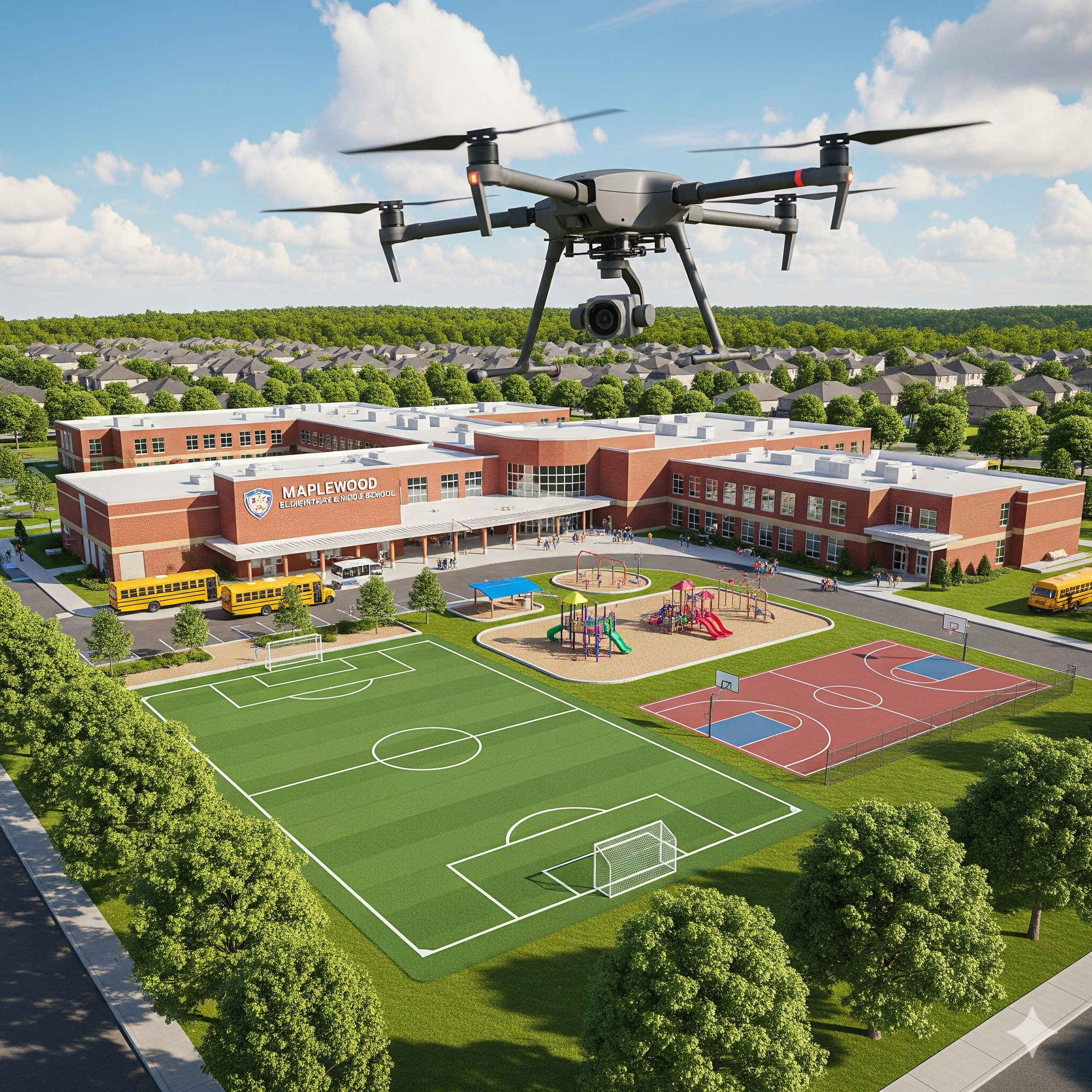
When schools conduct emergency drills, the goal is simple: move students and staff to safety as quickly and efficiently as possible. But the process of measuring and improving those drills is far from simple. Traditionally, administrators and safety officers observe from the ground, making notes about timing, order, and compliance. While valuable, this perspective often leaves critical blind spots in understanding how people actually move through a campus during high-stress situations.
This is where drones are changing the equation.
Why Aerial Data Matters
A drone provides more than just an overhead view—it provides actionable data. From 50 to 200 feet above a school, drones capture real-time footage of evacuation patterns across the entire property. Instead of piecing together observations from multiple staff members, safety teams can analyze a complete visual record of the drill from start to finish.
This aerial perspective allows for a system-wide analysis of:
Evacuation flow: how quickly students disperse from classrooms to designated safe zones.
Bottleneck areas: where large groups slow down due to narrow exits, stairwells, or pathways.
Exit utilization: whether all available routes are being used or if certain doors are consistently overloaded.
Time to clearance: the total time it takes to fully evacuate specific buildings or the entire campus.
From Observation to Optimization
Drone footage can be paired with video analytics software to quantify metrics such as crowd density, flow rates, and dwell time in specific areas. This data transforms drills from simple compliance exercises into opportunities for continuous improvement.
For example:
If footage shows a consistent backlog at a particular gate, schools can adjust staff placement, add directional signage, or even designate alternate routes.
If one side of a building clears faster than another, administrators can redistribute exit assignments to balance the load.
Time-stamped video allows safety officers to benchmark current evacuation times and track improvements across multiple drills.
Creating a Feedback Loop
One of the biggest advantages of drones is their ability to support iterative improvement. Each drill produces measurable insights that can be tested and refined in subsequent exercises. Over time, this creates a feedback loop where evacuation procedures become more efficient, predictable, and reliable.
Building a Culture of Preparedness
While drones provide technical insights, their use also signals something bigger: a commitment to proactive safety. By adopting advanced tools, schools demonstrate to staff, students, and parents that drills are not just routine, but part of a data-driven strategy to protect the community.
Drones are more than an innovative gadget—they’re a critical tool in modern school safety planning. By capturing comprehensive evacuation data from above, they give administrators the insights needed to identify weaknesses, test solutions, and continuously improve. In emergency preparedness, every second matters. With drones, schools gain the perspective—and the precision—needed to make those seconds count.